


Page 13 - CAN-16-26153 - Cancer Institute 2015 Outcomes Report
P. 13
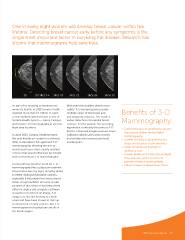
One in every eight women will develop breast cancer within her
lifetime. Detecting breast cancer early before any symptoms is the
single most important factor in surviving the disease. Research has
shown that mammograms help save lives.

As part of its ongoing commitment to             With even the smallest details more       Benefits of 3-D
women’s health, in 2015 Summa Health             visible, 3-D mammograms provide           Mammography:
invested more than $4 million to open            multiple views of the breast and
a new multidisciplinary breast center at         any suspicious masses. The result is      •	 Earlier detection of small breast cancers
Summa Health System — Akron Campus               earlier detection of potential breast        that may be hidden during digital
and install 3-D mammography at all of its        cancers. For the patient, the screening      mammography
eight area locations.                            experience is virtually the same as 2-D,
                                                 but the enhanced imaging assures fewer    •	 Greater accuracy in pinpointing size,
In June 2015, Summa Health became                callbacks, which saves time, money           shape and location of abnormalities
the only healthcare system in northeast          and anxiety over unnecessary tests
Ohio to introduce FDA-approved 3-D               and biopsies.                             •	 Fewer unnecessary biopsies or
mammography, allowing doctors to                                                              additional tests
view breast tissue more clearly and find
cancers that would otherwise be missed                                                     •	 Greater likelihood of detecting multiple
with conventional 2-D mammography.                                                            breast tumors, which occur in 15
                                                                                              percent of breast cancer patients
Tomosynthesis (another word for 3-D
mammography) lets a physician examine                                                      •	 Clearer images of dense breast tissue
breast tissue layer by layer, detail by detail,
to better distinguish invasive cancers,
especially if the patient has dense breast
tissue. X-ray machines are used to take
pictures of thin slices of the breast from
different angles and computer software
is used to reconstruct an image. 2-D
images are flat, like looking at a book
cover and have been shown to miss up
to 20 percent of early cancers. But 3-D
mammograms let a physician see all of
the book’s pages.

                                                                                           2015 Outcomes Report 13

