


Page 11 - Summa Health Vitality Winter 2018
P. 11
Taking Care

            of business

#1 10, 20or 30

                                                              Bathroom Trips Per Day?

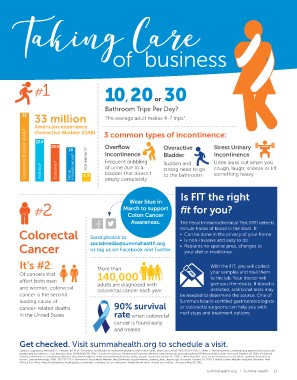
33 33 million                                                 The average adult makes 4-7 trips7

Americans experience

Overactive Bladder (OAB) 3 common types of incontinence:
Overactive Bladder (OAB)1,2
           Asthma322.618                                      Overflow              Overactive      Stress Urinary
                      Diabetes420.9                           Incontinence          Bladder          Incontinence
                                 Fecal
                                   Incontinence5              Frequent dribbling    Sudden and       Urine leaks out when you

                                             Alzheimer’s3     of urine due to a     strong need to go cough, laugh, sneeze or lift

                                                         5.3  bladder that doesn’t  to the bathroom  something heavy
                                                              empty completely

  #2                                                                               Wear blue in   Is FIT the right
                                                                               March to support   fit for you?
Colorectal
Cancer                                                                            Colon Cancer    The Fecal Immunochemical Test (FIT) detects
                                                                                    Awareness.    minute traces of blood in the stool. It:
It’s #2:                                                                                         •	 Can be done in the privacy of your home
                                                              Send photos to                      •	 Is non-invasive and easy to do
Of cancers that                                               socialmedia@summahealth.org         •	 Requires no special prep, changes to
affect both men                                               or tag us on Facebook and Twitter.
and women, colorectal                                                                               your diet or medicines
cancer is the second
leading cause of                                              More than                                               With the FIT, you will collect
cancer-related deaths                                                                                                 your samples and mail them
in the United States                                          140,000                                                 to the lab. Your doctor will
                                                                                                                      give you the results. If blood is
                                                              adults are diagnosed with                               detected, additional tests may
                                                              colorectal cancer each year         be needed to determine the source. One of
                                                                                                  Summa’s board-certified gastroenterologists
                                                                   90% survival                   or colorectal surgeons can help you with
                                                                   rate when colorectal           next steps and treatment options.

                                                                       cancer is found early
                                                                       and treated

Get checked. Visit summahealth.org to schedule a visit.

Statistics supplied by Medtronic: 1. Stewart, W.F et al. Prevalence and Burden of Overactive Bladder in the United States. World Jrnl of Urol 2003:20:327-336; 2. Serels S. The wet patient: understanding patients with overactive
bladder and incontinence. Curr Med Res Opin. 2004;20(6):791-801; 3.Centers for Disease Control and Prevention Website. http://www.cdc.gov/asthma/brfss/03/lifetime/tableL1.htm. Accessed October 18, 2010; 4. National
Diabetes Information Clearinghouse Website. http://www.diabetes.niddk.nih.gov/dm/pubs/statistics/#y_people. Accessed October 18, 2010; 5. Whitehead W.E. et al. Fecal Incontinence in US adults: epidemiology and risk
factors. Gastroenterology. 2009; 137:512-517; 6. Alzheimer’s Association Website. http://www.alz.org/alzheimers_disease_facts_figures.asp. Accessed October 18, 2010; 7.Health Grades Website. Frequent Urination: How
Often is Too Often: http://healthguides.healthgrades.com/simple-solutions-for-an-overactive-bladder/how-often-should-you-urinate. Accessed May 28, 2015.

                                                                                                                                                           summahealth.org I Summa Health 11

