


Page 5 - Summa Health Vitality Winter 2018
P. 5
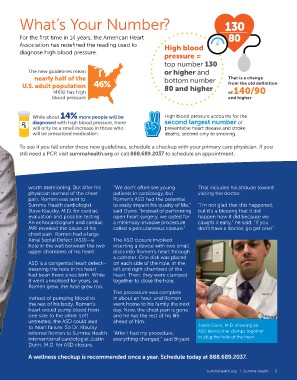
What’s Your Number?                                                             130

For the first time in 14 years, the American Heart  High blood                  80
Association has redefined the reading used to       pressure =
diagnose high blood pressure.                       top number 130                That is a change
                                                    or higher and                 from the old definition
   The new guidelines mean         46%
                                                    bottom number                of 140/90
     nearly half of the                             80 and higher
U.S. adult population                                                             and higher

                   (46%) has high
                  blood pressure

14%While about  more people will be                 High blood pressure accounts for the

diagnosed with high blood pressure, there           second largest number of

will only be a small increase in those who          preventable heart disease and stroke
                                                    deaths, second only to smoking.
will be prescribed medication.

To see if you fall under these new guidelines, schedule a checkup with your primary care physician. If you
still need a PCP, visit summahealth.org or call 888.689.2037 to schedule an appointment.

worth mentioning. But after his         “We don’t often see young               That includes his attitude toward
physician learned of the chest          patients in cardiology, but             visiting the doctor.
pain, Romen was sent to                 Romen’s ASD had the potential           “I’m not glad that this happened,
Summa Health cardiologist               to really impact his quality of life,”  but it’s a blessing that it did
Steve Klautky, M.D. for cardiac         said Dunn. “Instead of performing       happen how it did because we
evaluation and possible testing.        open heart surgery, we opted for        caught it early,” he said. “If you
An echocardiogram and cardiac           a minimally-invasive procedure          don’t have a doctor, go get one!”
MRI revealed the cause of his           called a percutaneous closure.”
chest pain. Romen had a large                                                   Justin Dunn, M.D. showing an
Atrial Septal Defect (ASD)—a            The ASD closure involved                ASD device that clamps together
hole in the wall between the two        inserting a device with two small       to plug the hole of the heart
upper chambers of his heart.            discs into Romen’s heart through
                                        a catheter. One disk was placed
ASD is a congenital heart defect—       on each side of the hole, in the
meaning the hole in his heart           left and right chambers of the
had been there since birth. While       heart. Then, they were clamped
it went unnoticed for years, as         together to close the hole.
Romen grew, the hole grew too.
                                        The procedure was complete
Instead of pumping blood to             in about an hour, and Romen
the rest of his body, Romen’s           went home to his family the next
heart would pump blood from             day. Now, the chest pain is gone
one side to the other. Left             and he has the rest of his life
untreated, the ASD could lead           ahead of him.
to heart failure. So Dr. Klautky
referred Romen to Summa Health          “After I had my procedure,
interventional cardiologist Justin      everything changed,” said Bryant.
Dunn, M.D. for ASD closure.

A wellness checkup is recommended once a year. Schedule today at 888.689.2037.

                                                                                summahealth.org I Summa Health 5

