Listen Up! It May Be Time to Get Your Hearing Checked
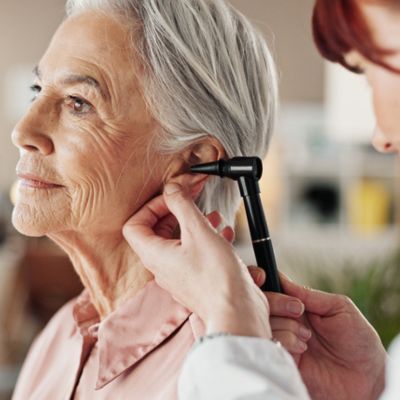
Hearing is one of the important senses for obvious reasons: You need to hear to communicate and connect with others! But, did you know the ability to hear also is crucial for maintaining other aspects of your health, such as your balance and brain health?
It’s true. Hearing loss can significantly impact your daily life, and studies show it can lead to social anxiety and isolation, an increased fall risk, dementia and depression.
Unfortunately, hearing loss is a common problem as we age. According to the National Institute on Deaf and Other Communication Disorders, nearly 25 percent of people ages 65 to 74 and more than half of those who are 75 and older have disabling hearing loss. Additionally, about 15.5 percent of people 20 years and older have some hearing loss, according to NHANES.
Hearing loss can occur in one or both ears. It can happen suddenly through trauma or gradually as the small hairs in your ears become damaged over time from aging or chronic noise exposure.
The American Speech-Language-Hearing Association recommends annual hearing tests for all adults beginning at the age of 60, regardless of whether they are experiencing symptoms. Even if you don’t believe you have any hearing loss, it’s a good idea to check in with an audiologist to assess your ear health and establish a baseline of your hearing.
6 signs it’s time for a hearing test
Changes in your hearing can develop slowly and they may not be immediately noticeable. Thus, signs of hearing loss can go undetected for quite a while.
Signs of hearing loss include:
1. Frequently asking others to repeat themselves.
Conversations — both in-person and on the phone — can feel like a struggle and you might find yourself repeatedly asking, “Can you say that again?” You also may twist your neck or body to hear what’s going on.
2. Ringing in the ears.
Known as tinnitus, ringing in the ears can be an early sign of hearing loss. The noises also can sound like static, buzzing or crickets. At times, you also might have dizziness, vertigo or notice some sensitivity to loud sounds.
3. Difficulty hearing in certain environments.
You might struggle to follow conversations in certain situations, such as noisy, crowded spaces or in groups with multiple talkers. You may even find that you begin to avoid social settings or withdraw from conversations.
4. People around you seem to mumble.
You might be able to hear sounds in conversation, but you can’t understand what the person is saying, and you ask the person to speak more clearly. You find holding conversations leaves you drained.
5. Turning up the volume.
You find yourself struggling to hear while on the phone, watching TV or listening to the radio and constantly are turning up the volume. You might start to rely on subtitles.
6. Family history or chronic noise exposure.
Chronic exposure to loud noises can be a main contributor to hearing loss. This can be come things like listening to loud music, going to concerts or even using lawn equipment if you’re not wearing proper hearing protection. However, inherited abnormalities and conditions can increase your risk, as well.
Seek medical attention right away if you’re experiencing balance problems, a severe earache or sudden hearing loss. It could be a sign of a serious underlying condition.
What to expect at a hearing test
During a hearing test, your audiologist will likely first ask about your ear health history and hearing loss symptoms. Then, your provider will perform a physical ear exam. Your audiologist will look inside your ear to make sure there aren’t any blockages, such as ear wax or fluid. The provider also may perform several other tests, such as a pressure test to ensure your eardrums are functioning properly or others to see how well your brain processes sound.During the actual hearing test to measure your hearing, you’ll be asked to listen and identify sounds with different pitches and volumes in both ears. You may also be asked to listen to speech at different volumes and repeat back the words.
If your results indicate a hearing problem, the good news is you don’t have to suffer in silence. While hearing loss is typically not curable, it is almost always treatable. Talk to your healthcare provider about which treatment options are right for you, so you can get back to enjoying life and be in tune with the world — and loves ones — around you.
If you’re ready to schedule a hearing test, learn more about Summa Health’s ENT and Audiology services.
About the author

Vitality General Wellness eNews Sign Up
Receive the Summa Health eNewsletter for the latest health tips, advice and updates.