Transcription:
Breast Surgery & Reconstruction – What to Expect at Every Step, Part 1: Before Surgery
Scott Webb (Host): Welcome to the first episode of a three-part series on breast surgery and reconstruction. In part one today, I'm going to discuss the options that breast cancer patients have and how the team of surgeons at Summa Health work together to help patients make the best choices for their lives and goals.
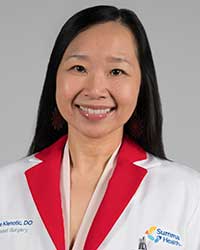
Joining me is Dr. Eve Klenotic. She's a specialist in breast surgery and breast surgical oncology. And I'm also joined by Dr. Mike Tran. He's a plastic surgeon, and they're both with Summa Health.
This is Healthy Vitals, a podcast from Summa Health. I'm Scott Webb. It's very nice to have you both here today. We're going to do a three-part series, and this being part one of this panel discussion about breast surgery and reconstruction, kind of what patients can expect, you know, along the way, every step, if you will. And Dr. Klenotic, I'm going to start with you. When you first meet a patient, what do you want them to understand about the reconstruction options?
Dr. Eveline Klenotic: First, thank you so much for having us, Scott. When I meet patients for the first time, I want them to know that there are options and they have choices. Gone are the old days where doctor says A and you have to do A. They do have options, whether they choose breast-conserving surgery or a mastectomy.
Host: Yeah. And I think that that's going to be music to some folks' ears, especially knowing that they have options. There are options. We all want them as patients and, of course, doctors are patients too. So, Dr. Tran, how do decisions like lymph node removal impact, you know, let's say risk long-term?
Dr. Mike Tran: The decision for lymph node removal is more related to the breast cancer treatment side of things. It does definitely affect your risk of developing BCRL, so-called breast cancer-related lymphedema. And a good way to kind of understand it is you think of the lymphatic system like a network of streets that carries the fluid away from the arm.
So if we remove a few lymph nodes, there are usually still plenty of other streets available, so the traffic keeps moving. But if we remove more lymph nodes or add radiation to the mix, see more of those streets get damaged or blocked. And then now you have fewer open roads, and it's easier for a traffic jam to happen.
And that traffic jam is essentially lymphedema. So, you know, that is essentially an analogy for someone undergoing surgery of the axilla, which affects the lymph node of the axilla. So again, this does not mean that someone undergoing an axillary lymph node dissection with radiation is going to get lymphedema. It just affects and increase the risk of having it. And the risk is not all or nothing. So again, if you imagine removing a couple of sentinel lymph nodes is completely different than having a lot more lymph nodes removed during an axillary lymph node dissection. And then, if you're required to have radiation after that, that increases the risk. So, I try to give a patient a realistic idea as to where they fall on that spectrum.
Dr. Eveline Klenotic: I love that, Dr. Tran. I'm going to steal that analogy for my next discussion.
Host: Yeah, it's a perfect analogy, especially for a layperson like me. I understand, we all understand traffic and roadblocks and road jams and all of that. So, Dr. Klenotic, when does oncoplastic surgery come into play versus traditional reconstruction?
Dr. Eveline Klenotic: Great question. So, the term oncoplasty is typically used with breast-conserving surgery. So meaning we are saving some of the breast tissue and reconstructing it, reshaping it so that we are not leaving the patient with significant deformity, as opposed to the traditional breast reconstruction, which is typically accompanied after doing a mastectomy or removal of most of the breast tissue, 95% of the breast tissue
Host: Okay,
Dr. Mike Tran: for some patient, the right cancer treatment for them involves moving only a portion of the breast. So if she's keeping most of her breast, after removing the breast cancer, the defect can be very deforming. This can be a big dent, the distortion, the nipple can pull one way or the other. There's asymmetry. So instead of saying, you know, "Let's take the cancer out and see what it looks like afterwards," we plan the reconstruction at the same time, right? So, the excision is made by the breast surgeon who removes the cancer with the appropriate margin, and then the plastic surgeon or reconstructive surgeon comes in and then use the remaining breast tissue to rearrange it to restore the shape. And the techniques that we use is very, very similar to the techniques we use in breast lift or breast reduction. And we may also operate on the opposite, the contralateral side to improve the symmetry afterwards.
Host: Yeah. And it makes perfect sense as you're saying, Dr. Tran, like this is all a part of a plan, right? And shared decision-making between surgeons and patients and all of that. And rather than just saying, "Well, let's just see what it looks like when we're done," you have this plan going in. And it makes me wonder, Dr. Tran, like, are there some surgical approaches today that really can help reduce long-term complications or risks?
Dr. Mike Tran: I'm glad you asked that. That's a very nice segue.
Host: I try.
Dr. Mike Tran: Yeah. Throughout history, we've always tried to improve and and strive for better outcomes. So, breast surgery nowadays has become much more tailored and individualized. On the cancer treatment side, I hate to overstep my boundaries, but it seems to me that with mastectomies, we're trying to preserve much more of the patient's normal breast skin. And in some patients, we can preserve the nipple.
With the lymph nodes, we're trying to preserve those that don't need to actually be removed as much as possible while maintaining a safe oncological treatment. And on the reconstructive side, you know, implant reconstruction has changed quite a bit in terms of, like, where the implant's placed, how we support the tissue. We use a matrix to protect the anatomy. With the reconstruction, we're now using more and more of patient's own tissue. We now use sophisticated techniques with an emphasis on functional preservation of the donor site.
And then, finally, even for patients that are high risk for lymphedema, we now use super microsurgical techniques where we reconnect very small lymphatic vessels to a nearby vein at the time of the lymph node surgery to prevent or lower the risk of having lymphedema. It's not something we have routinely years ago, but now it's another tool that helps us with the lymphedema and complications of surgery
Host: Right. Yeah. And wondering, Dr. Tran, maybe what are, let's say, one to two questions you wish every patient would ask before surgery?
Dr. Mike Tran: So, sort of paternalistic here, but you want to ask questions that help you choose between reconstructive options from at least from a reconstructive standpoint. So first, I like for patient to come in and, you know, ask, "What are all of my reasonable options?" See, it's not just the most common option, but all the reasonable option for me.
Because sometimes patient comes in, and they believe that reconstruction is just one surgery and one-size-fits-all. And it's just, you know, one reconstruction that they're supposed to have. That's usually not the case. And after that, once we've kind of discussed through all the reconstructive options that's appropriate for that particular patient, then I would like for them to start thinking about, "If I choose this particular option, what am I signing up for over the next year?" Not just what happens on surgery day, right? Because breast cancer treatment is a sequence. Treatment can involve surgery, it can involve radiation. Radiation can affect the reconstruction, and then reconstruction affects the recovery. So, what you want to understand is not just the next operation, but the overall plan, right? How many options or operation might I need? How long is recovery? What's going to happen if I need radiation? Does this involve an implant that may need another operation someday? Can I use my own tissue? What does it do to the donor site? Questions like that.
Host: Yeah. And as I said as we got rolling here, Dr. Klenotic, we're going to do three parts to this series, and we hope folks will listen to all three parts and listen in order. But either way, as we finish up today part one, why is it important to involve both the breast surgeon and reconstructive surgeon in planning?
Dr. Eveline Klenotic: We truly feel that being able to see both the breast surgeon and the plastic surgeon or reconstructive surgeon provides patients with wealth of knowledge and options. They're able to see some samples of images of like before and after, kind of ask questions, and it would empower them to make the best choices for themselves.
And cancer diagnosis is quite overwhelming, and sometimes that first visit, they might still be in the processing phase of the diagnosis and may not be able to retain information or process the options that we're giving them. But then if they also see the plastic surgeon, then they'll have more questions and be able to absorb the information better and make the best decisions for themselves.
Host: Right.
Dr. Mike Tran: It's a huge advantage for us to have these conversation beforehand. Surgery is a big deal, right? So, the best operation obviously is usually planned outside of the OR. And we each have our own jobs, and we're able to meld and complement whatever we do. See, the breast surgeon focuses on what has to come out and treat the cancer safely.
And the reconstructive surgeon, they're thinking about what tissue is being removed, what's left over, what's the skin going to look like afterwards, and how are we going to rebuild the breast in a way that's safe, it's durable, and it fits what the patient wants. So, all these things affect each other. And so again, it's just a huge advantage for us to be able to confer prior to surgery.
Host: Right. Yeah, it certainly sounds like a team approach at Summa Health. And I love hearing all of it today. I can't wait for part two where we're going to talk more about surgical approaches and reconstruction choices. But for today, thank you so much.
Dr. Eveline Klenotic: Thank you.
Dr. Mike Tran: Absolutely. No problem.
Host: And for more information, go to summahealth.org/breast. And if you enjoyed this episode of Healthy Vitals, we'd love it if you'd leave us a review. Your review helps others find our educational content. I'm Scott Webb. Thanks for listening, and we'll talk again next time.
.webp "Mike Tran, MD")