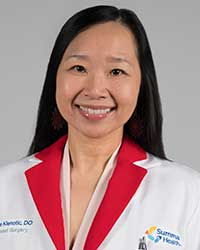
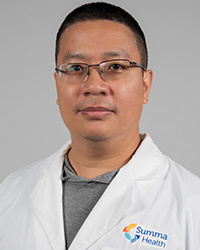
Scott Webb (Host): Today we are wrapping up a three-part series on breast surgery and reconstruction by focusing on what happens after surgery. I'm joined again today by a couple of expert surgeons from Summa Health. Plastic surgeon Dr. Mike Tran is here again, as is Dr. Eve Klinotich. She's a specialist in breast surgery and breast surgical oncology
This is Healthy Vitals, a podcast from Summa Health. I'm Scott Webb.
Scott Webb: It's really nice to have you both back here. This is the third part in our three-part series, so we do encourage folks to listen to part one, where we talked about breast surgery and reconstruction. Part two was more focused on the surgery and the reconstruction, more specifically surgical approaches and reconstruction choices.
And today we're gonna talk recovery, prevention, and long-term wellness, you know, life after surgery here in part three. So, Dr. Tran, you're up first. What does recovery look like beyond, let's say, the first few weeks?
Dr. Mike Tran: I want people to know that recovery is much longer than just skin healing. A lot of people think that, "Okay, my incision's closed. I should feel normal now." But the tissue is still changing from months to year, right? The swelling goes down, scar is gonna soften, breast is gonna gonna start settling, tightness improves, the nerve starts to wake up, or sometimes if they stay numb, your strength starts to come back.
The fatigue you s- feel after major surgery, that can stay around for a, a little bit longer than what you expect. And of course, there's always the emotional side to it, right? You may physically be doing well, but you still have to process the diagnosis, the surgery you went to, your body changing, and the fear about recurrence, right?
So my post-op schedule is usually one week after surgery, then three weeks, then three months, then a year. So I always tell patients, "Don't judge where you are. Like, don't judge where you're gonna end up based on how you feel at three weeks." Three weeks is very, very
Scott Webb: Right. In the big picture, three weeks is not a long time and sounds more analogy-wise, more a little bit more like a marathon than a sprint, right?
Dr. Mike Tran: That's exactly right
Scott Webb: Yeah. And staying with you, Dr. Tran, and you've established for us, you benefited from your expertise in these podcasts that there's a lot of reconstruction choices and options.
So when we think about those choices, how do they affect mobility, healing, and quality of life?
Dr. Mike Tran: Well, there are trade-offs to every reconstruction, and this is why the reconstruction has to be individualized, right? For instance, with an implant, we're not operating on another part of the body, so the initial recovery is gonna be simpler. But you do have an implant in your body, and the implant can develop scar tissue around them.
They move, they rupture, get infected. They may even require another operation later on. There's a maintenance cost to it, right? Whereas when you're using your own tissue, there's a bigger cost up front. For instance, if I take tissue from the abdomen, now you're recovering from the breast operation, but you're also recovering from the abdominal operation.
But once that heals, it's your own tissue. It gains the weight, it lose weight the same as you, and it behave more naturally over time. So higher cost up front. You can see how with all these reconstructive iteration, neither is universally better, right? It's more individualized. What's better for a young, healthy woman who wants to avoid implants?
That may be completely different than what's better for a 70-year-old grandmother who wants the shortest reasonable operation
Scott Webb: Yeah, it definitely, sounds like it's not one-size-fits-all. And as we've learned and benefited from your expertise, both of you, over these podcasts, it's a, a team approach at Summa Health, shared decision-making with the patients, sometimes even on the table, during surgery. And Dr. Konotick, what's one thing patients can do to reduce their risk of lymphedema?
Dr. Eveline Klenotic: Mm-hmm. I don't know if there's just one thing, Scott. It's, multiple things. But with lymphedema, it is very important to detect it early, and prevention is key, right? So, depending on what type of procedure they had, if they only had a few lymph nodes out, and no radiation, the risk of lymphedema is actually quite small, like two to five percent.
But it is a possibility. So arms exercises, routine screening and follow-up, and that's part of the national guideline to make sure that they keep up with the screening. And we have this fancy machine called LDex that kind of detects the fluid pressure in the arm before patient has symptoms, so that if we detect a major change, even before they notice it themselves, we can intervene and prescribe an arm sleeves or send them to the physical therapist that specialized in lymphedema prevention, and hopefully we can get ahead of, the lymphedema.
And maybe Dr. Tran can chime in later. Lymphedema has different stages, and in the early stages is still very much treatable. However, in the later stages, it's, non-reversible. And, there are also some myths associated with lymphedema risk. I think, most people would be so afraid to do IV and blood pressure cuff on the side of surgery.
And while it is true, if we have two arms and the other one had no surgery, then it's okay to use that arm, you know, if it's available. But in general, if they've had minimal axillary surgery or lymph node removal, and especially if they didn't have radiation and no lymphedema symptoms, it is okay to use that same arm for IV, for vaccine, for blood draw, for blood pressure cuff.
And especially if it's an emergency situation, we often see it when we do trauma care, you know, and they come-- a patient come from a car accident, and they're really sick, but they write in the headboard, "Do not use this arm for IV." In that situation, please save her life.
You know, you can use the arm. So, but yeah, those are kind of myths. In general, it can be used. But of course, if the other arm is available, you know, it doesn't hurt to use the other arm
Scott Webb: Right. Yeah, Dr. Tran, I wanted to ask you, staying with lymphedema, what are some of the warning signs that patients should never ignore?
Dr. Mike Tran: the early lymphedema signs, it may not look dramatic. It might just be, "Hey, my arm feels heavy today," or, "My watch feels tighter. My ring suddenly doesn't fit too well." Right? It's very subtle,
Scott Webb: Yeah
Dr. Mike Tran: right? And so it's something, you know, if it's persistently different between the two arms, I would rather just hear about it, bring it up, you know, and that way we can identify it early.
And having identified it early, there are more options that we can have to manage it and keep it from progressing, and that's really the name of the game with lymphedema
Scott Webb: Yeah, as Dr. Klonotich was saying, early diagnosis is key. A- and Dr. Klonotich, when we think about, you know, just recovery in general, like what are some of the common surprises, I guess, maybe that patients experience during recovery?
Dr. Eveline Klenotic: Yes. I think most of my patients would say, "Oh, the pain is not as bad as I thought," you know, because it is a big surgery, , sometimes and-- But actually, most people would have more numbness than pain, and that, is a surprising thing for them, too, that the, areola or the breast can be numb or decreased sensation.
And a lot of patients now that we are doing more and more what we call oncoplastic surgery, which is removing the cancer but reshaping the breast at the same time to decrease deformity, and it provides like breast lift and better appearance, than if we didn't do anything. I think patients are usually very happy with the outcome after oncoplastic reduction and symmetry surgery.
And they often say, "I should have done this a long time ago even without cancer,"
Scott Webb: Yeah, sure
Dr. Eveline Klenotic: yeah.
Scott Webb: Yeah. So, Dr. Tran, let's talk long-term outcomes. Uh, I think you've said along the way here about just being sort of realistic and honest with patients. So, what can they realistically expect after breast surgery and reconstruction?
Dr. Mike Tran: Yeah, I think most patients can expect to get back to a very normal life. That means work, exercise, travel, swimming, wearing normal clothes, all that is usually achievable, okay? But I also don't like pretending that reconstruction makes the cancer experience disappear. You're gonna have scar, you may have area that's numb.
You may need to have another procedure somewhere down the road. If you have an implant, you have to remember that it's not necessarily a lifetime device. If you're using your own tissue, the reconstruction will change and age with your body, right? So to me, a happy ending is when the reconstruction stop occupying so much space in the patient's life.
They're not waking up every morning thinking about their breast reconstruction. It just becomes a part of their body and they go on to live their life
Scott Webb: Right. They go on and play pickleball and go to work and as you say, travel, wear a bathing suit, whatever it might be. It's been great stuff over these three episodes, very, educational. I, I hear the expertise, the compassion in your voices, a- all of it, which I'm sure is very meaningful to patients, prospective patients, their families.
Dr. Klentic, I want to finish up with you here in this last part of part three. What message would you most like newly diagnosed patients to hear as they begin what is, I've learned from you all over these podcasts, is really a journey?
Dr. Eveline Klenotic: I really think that all of us who are in this profession, we're very passionate about breast cancer care because breast cancer is very common. We know somebody in our circle that has it. And likewise, we are here for you every step of the way for every patient. We are a great team, and Summa is very lucky to have seven plastic surgeons who are here to help, one piece of the reconstruction or recovery journey for the breast cancer a little bit more manageable
Dr. Mike Tran: Just to add to what Dr. Klaproth is saying, and to you, Scott. Yes, indeed, it is a journey, and I want patients to understand that they don't have to understand everything on day one, right? 'Cause I imagine a patient going in there, they get told that they have breast cancer, and then immediately we start throwing enormous amount of information at them, like surgery, lymph nodes, radiation, chemo, reconstruction, and then we ask them to make a decision about it.
And they're-- And then they're probably not having heard some of the words that we're saying,
Right.
And so I, I always tell patients, ask a bunch of questions. Ask the same question twice if you need to, and bring somebody with you. Write things down, Understand there's several medically reasonable paths, right?
And so as long as you understand the overall bird's eye view, you know, our job is not trying to push you into one operation or the other. My only job is to explain the options and explain the trade-offs, make sure the cancer is treated appropriately, and then help you choose the path that makes the most sense for you
Dr. Eveline Klenotic: Mm-hmm. Yes, I think that is, the key. That our job is to give the best options and education so that our patients and their family can make the best decisions for themselves
Scott Webb: Right. Yeah, that's perfect. And my job now is to put a period at the end of this sentence. I've really appreciated your time and expertise, throughout these three podcasts. We hope folks, of course, will listen to all three parts and listen to them in order, but it's their dime, their dance floor. We hope they, they listen, you know, at least to the parts that are relevant to them.
I want to thank you both for your time of this works. And as I said, you know, before that first one, you know, yes, breast surgery and reconstruction, but what can we expect every step of the way? And I think we've done that. We've talked through it all.
We provided that to listeners. So thank you so much.
Dr. Eveline Klenotic: Thank you, Scott. This has been so much fun.
Dr. Mike Tran: Absolutely. Great pleasure
Scott Webb (Host): And for more information, go to summahealth.org/breast
Host: And if you enjoyed this episode of Healthy Vitals, we'd love it if you'd leave us a review. Your review helps others find our educational content. I'm Scott Webb. Thanks for listening, and we'll talk again next time.