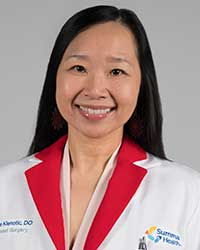
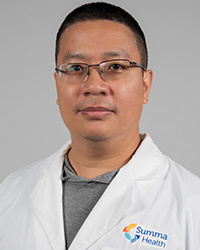
Scott Webb (Host): Today in part two of our three-part series on breast surgery and reconstruction, I'm again speaking with Dr. Eve Klenotic, specialist in breast surgery and breast surgical oncology, and plastic surgeon Dr. Mike Tran. And today we're speaking about surgical approaches and reconstruction choices at Summa Health.
This is Healthy Vitals, a podcast from Summa Health. I'm Scott Webb.
Scott Webb: It's nice to have you both back on the podcast. As I mentioned before, our first one, the last one, uh, we're doing a three-part series here on,, basically breast surgery, reconstr- reconstruction, what folks can expect, you know, every step along the way. And today in part two, and we do hope folks will listen to part one, but in part two today, we're gonna talk surgery and reconstruction specifically.
So, Dr. Klenotic, how do you work together during surgery to achieve optimal oncologic and reconstructive outcomes?
Dr. Eveline Klenotic: Hi, Scott. It's so good to be back. So before we work together during surgery, actually it's very, very important that we work together before surgery day. So we would plan how to approach the case beforehand. For example, today we happen to be in the same clinic together so we can discuss our patients, and I would let Dr.Tran know this is where the cancer is, and this is how much tissue I would like to remove, to make sure that the cancer is out. And then Dr. Tran would chime in, "Oh, yeah, I think we can use, , this part of the breast to reshape , and fill in the defect or the dent, that is caused by removing the breast tissue."
Or there are more complicated cases where someone may have several different spots of cancers in the same breast, and that's, termed extreme oncoplasty, for example. And I would consult Dr. Tran to see, is it even possible that my patient would like to still save her breast if she has this many cancer in her, in the same breast?
And so on the day of surgery, we often mark the patient together in the preoperative area so that we are in unison in terms of which area to remove and what type of, reconstruction would be done. On mastectomy patients, then I would kind of let Dr. Tran know, sometimes the skin needs to be removed, and sometimes we can save the nipple safely, from cancer perspective, and that would be communicated to Dr. Tran prior to surgery to plan together. So back to the day of surgery, we would mark the patient together in preoperative area, and we agree on the plan. And then, we also communicate and work together throughout the case, from making the incision, injecting any blue dye or tracer that we may need to preserve lymphatic and veins to be reconnected for, like, the bigger axillary surgery that, as Dr. Tran mentioned last episode, to reconnect the, channels so that the lymphedema risk can be minimized.
Scott Webb: Yeah, Dr. Tran, it really does sound like you guys really work together before, during, after, and makes me wonder how you balance the cancer treatment goals with cosmetic and the quality of life considerations
Dr. Mike Tran: the priority is pretty simple. You treat the cancer safely first, and this part is not negotiable. So I'm never gonna tell the breast surgeon, "Hey, leave that. It'll look better." Right? So once breast cancer is treated properly, and then we start to think about the cosmesis and quality of life.
So there used to be an attitude that patients should just be grateful that the cancer was treated, and who cares what the breast looks like afterwards. That's not right. Right?
Dr. Eveline Klenotic: Mm-hmm
Dr. Mike Tran: Have to consider the appearance, comfort, patient's physical activity, clothing, sexuality, and quality of life, right? These things are important because you still have your entire life to live after the cancer is treated. So in my mind, the goal isn't just to get someone through surgery. We want to treat the cancer and leave the patient with a result that lets her get back to her life.
Scott Webb: Yeah, and I was thinking about scarring, symmetry, expected outcomes, and what you, from your perspective, what do you really want patients to know about some of those concerns?
Dr. Mike Tran: I'm very frank with the patient regarding this. I tell the patient very clearly, "You will have scars. We can improve the shape of your breasts, we can restore volume, we create symmetry, but we cannot make the surgery itself disappear." The second thing I tell the patient is that a reconstructive breast is not a real breast.
We cannot make a new breast. It's an organ that has glands, connective tissue, right? We just reconstruct. What we have is a facsimile of a breast. We restore the shape, the volume, and the goal is to create a mound that looks natural in clothing. See, the other thing the patient don't realize is that the reconstruction changes over time.
The breast may look high, it's swollen, it's flat, it's bruised, and it may look maybe strange early on, but that's not the final result. I even say that even if the on-table reconstruction looks good, that might not be what you want. We have a pretty good idea how it will change over time from experience, and sometimes we account for those changes.
So although you can't predict the changes a hundred percent of the time, And oftentimes you may need smaller procedures later on, like fat grafting or scar revisions to kind of make it look a little more perfect or even in adjusting the opposite breast. But I just personally set the expectation that the reconstruction is a process rather than just one perfect operation
Dr. Eveline Klenotic: I think also, Scott, most people, most women don't realize that most women do not have symmetrical breasts. I often tell my patients, unless, , it's a Barbie coming out of the store, you know, most women do not have symmetrical breasts. So that is the normal, you know? So having said that, it is very, very important to set realistic expectation.
The breasts may continue to change over years of time, , based on radiation changes. And, , we always say they're sisters, not twins, you know? So, and I think a lot of people that goes through cancer, they kind of understand and, I think they cope with the changes better
Scott Webb: Right. such a, perfect analogy, right? We all are familiar with Barbie and how perfect Barbie tends to be. And in, if you weren't Barbie beforehand, you're definitely not gonna be Barbie afterwards. Dr. Knoedler, how has breast surgery and the reconstruction techniques evolved in the recent years?
Sounds like it's moving pretty fast.
Dr. Eveline Klenotic: Yes. You know, it's crazy to think that there was a time when a patient had a breast lump, a radical mastectomy was done that same day. Radical mastectomy is removing the breast tissue, the muscle, all the lymph nodes, and it leaves these women with significant deformity and long-term si- effects such as pain and lymphedema.
So as we evolved, breast cancer treatment, has gotten, we call it less and less, the term is de-escalation. So we routinely offer, for example, partial mastectomy instead of a full mastectomy because it's a safe option for a patient. for example as well, we are no longer routinely removing axillary lymph nodes or lymph nodes from the armpit, as long as the imaging exam beforehand is normal, especially for, women 50 and above.
And this way, the risk of lymphedema or the arm swelling would be much less
Dr. Mike Tran: our implant reconstruction now has become much more refined as well. , The implant technology has become so incredible. Gel leak rate is down. The shell on the implants are much stronger. We now routinely use dermal matrix to support the breast and the implant.
We've moved from putting the implant underneath the muscle to now above the muscle. We are able to now do the implant reconstruction the same time as a mastectomy rather than previously, where most of the time it's at a stage, reconstruction. our ability to use a patient's own tissue now has become much more sophisticated.
We're now routinely doing microsurgical reconstruction where we take skin and fat from elsewhere on the body and reconnect the blood supply under the microscope to rebuild the breast. We're also now more focused on doing that without sacrificing the functional muscle or creating significant donor site debilitation.
On the horizon, and that actually I think it's, already here, we're paying much more attention to things like sensation. We're able to now nuetralize the flap and give sensation to the reconstructive breast. And like what Dr. Klenotic was saying is we're also concentrating on lymphatic function, where we're able to do lymphopenias bypass, where we're reconnecting the lymphatics to the veins in order to lower lymphedema rates.
We're paying a lot more attention to, the quality of life The standard now is not did the flap survive or did the implant stay in? It's more, is this going to be a natural-looking reconstruction five to ten years down the line?
Scott Webb: So as we get close to wrapping up, episode two, if you will, of this three-part series, Dr. Klonotich, what are the reconstruction decisions made before surgery versus during surgery?
Dr. Eveline Klenotic: as we have kind of discussed throughout the podcast today, so prior to surgery, it's important to know if we are saving the breast or not. And then if we're not saving the breast, what type of reconstruction are we pursuing, whether it's implant or tissue-based reconstruction. And when we're talking about implant, there's different type of implants, but there's also, tissue expander, because a lot of times for some patient who we know for sure will need radiation, they would not be a candidate for the permanent implant.
Although that would be so ideal, right? One and done. Um, however, a lot of times for this patient who will have radiation, we would put a tissue expander until they're done with the radiation, and then they're reconstructed at a later time. So an example of reconstruction decision that is made during surgery, a patient who wants to have an implant, and ideally, it would be one and done.
However, during surgery, there are multiple factors that would affect how the tissue and the blood flow looks. And,, Dr. Tran has a special fancy machine checks the blood flow of this, we call it flap of the skin, after the breast tissue is removed. And if that's healthy enough, then the permanent implant can be placed.
But if it's not healthy enough, we want to do the safe thing and put the expander placement and eventually train the skin slowly to stretch so that next time when it's ready, the permanent implant can be placed and the skin would look nice
Scott Webb: Right
Dr. Mike Tran: To kind of add on to what Dr. Klanotic is saying, see, it's a major advantage for us to have this discussion before the surgery, and it also allows us to have the patient peek into our thoughts so they can also participate in patient-centric decision-making, right? I always tell patients that the surgery does have some built-in uncertainty.
Like, we have a plan coming in, but sometimes, like Dr. Klanotic pointed to,\, is the skin of the mastectomy. Sometimes the skin doesn't look great, or maybe it does. Sometimes it doesn't. Maybe we have to change the plans mid-surgery or intraoperatively, right? And so I don't really give a patient one rigid plan.
I usually tell them, "Look, here's plan A, right? And here's what would make me change to plan B. And here's what plan B looks like." That way, if we make a different decision in the operating room, it's not a surprise. Everyone's involved
Dr. Eveline Klenotic: Mm-hmm. Mm-hmm. Yes
Scott Webb: Yeah, that's perfect. And, as I mentioned, you know, we're doing this three-part series. This is part two. So talked a lot about surgery and reconstruction today. In part three, when we speak again, we're gonna talk more about recovery, prevention, long-term wellness, basically life after surgery. But great having you both on and talk to you soon.
Thanks so much
Dr. Mike Tran: Thank you
Dr. Eveline Klenotic: Thank you, Scott
Scott Webb (Host): And for more information, go to summahealth.org/breast
And if you enjoyed this episode of Healthy Vitals, we'd love it if you'd leave us a review. Your review helps others find our educational content. I'm Scott Webb.
Thanks for listening, and we'll talk again next time.